NAZA the movie

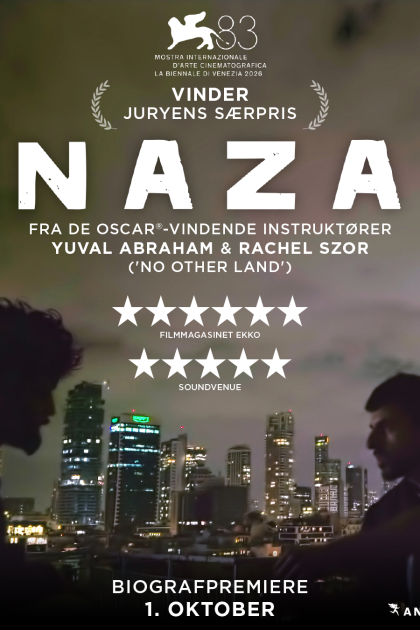
Last night I went to a preview screening at the Grand Teatret in Copenhagen of NAZA, organised by the Palestine Film Days. Three sold-out screenings with English subtitles ahead of the Danish cinema release next Friday.
The man from the Palestinian Cultural Institute who introduced the film (in English) kept referring to it as a movie. In my head I kept autocorrecting to ‘documentary’. But as I told him when we talked in the cafe after the screening, I now understood.
I know the images aren’t the aspect of NAZA that everybody talks about. I had been expecting undercover journalism; 'shot on rooftops at night' was the most that any review I'd read had said about NAZA as a film.
The camera is indeed constantly on the rooftop at night, but it is what it sees that matters. Looking closely through the windows the apartment buildings, office blocks, and cars streaming on highways. We are observing and surveilling Tel Aviv. We see inside people’s homes in these vertical cities, never seeing their faces of course but seeing the banality of their everyday lives. Washing up, exercising, relaxing, and often with big screen TVs in shot showing news presenters giving Israel's version of what is happening. Like Andreas Gursky's photographs, the film shows us how people live separate but entirely connected existences in the hives of these apartment blocks, and they could be all of us.
In top shot we see people cycling and sitting in cafes. Interviewees recounted how they would go from setting up mass killings on a computer to going out with friends and, as one said, back to my studies in clinical psychology.
There was a remarkable tableau of people stopped on the street standing next to their cars as a siren started to mark Holocaust Memorial Day - and then quickly getting back into the cars to drive on as the moment for reflection ended.
There was carefully chosen archive to show how all Gazans are surveilled by Israel all the time, and how Israel generously built the telecoms system - so that they could monitor it
I also was struck by the compelling way Yuval Abraham, co-director with Rachel Szor, asked some of the interviewees to draw in notebooks - simple line drawings of buildings that would be destroyed, stick figures of the victims.
I've only been twice to Tel Aviv, most recently in 2018. The film gave me an insight into what it feels like to be an Israeli working in this war machine obliterating people and buildings 60km away on the same coastline. A comment I read said: 'Everyone needs to see this film and see what happens when you mix mass trauma, mass dehumanization, no accountability, and the outsourcing of systemic widespread killing to AI. AI is a central part of the killing.'
The end of the film is a gut punch sequence from Gaza of one father calling for his family buried beneath rubble.
“NAZA is grounded in rigorous journalism published over the past three years,” said Harry Davies, a Guardian investigations correspondent and one of NAZA’s producers. “But it is also a powerful piece of cinema that will soon be available on screens, large and small, around the world.”
I hope that many of you get the chance to see the film. We see NAZA because it is produced by the Guardian, distributed by MK2, and because the Israeli directors had the access to the story. We need to hear the Palestinians who tell this story too.
if you're in Copenhagen, the Palestine Film Days are on from October 18-24th at the Grand.